
Prefabricated housing in Poland is not a single category. Several structurally and technically distinct systems are available, each with different manufacturing processes, transport requirements, on-site assembly methods, and performance characteristics. Understanding these differences is a prerequisite for comparing quotes, evaluating timelines, or assessing compliance with WT 2021 energy standards.
1. Volumetric modular construction
Volumetric modules are three-dimensional box units — typically steel or CLT (cross-laminated timber) frames — that are manufactured and fitted out in a factory before being transported to the site. Each module arrives with walls, floor, ceiling, and in many cases windows, doors, electrical conduit, and plumbing rough-in already installed.
On site, a mobile crane lifts the modules onto prepared foundations and stacks or arranges them according to the design. Structural connections between modules are made at the joints. Utility connections are then completed between modules and to the site infrastructure.
Typical characteristics — volumetric modules
- Factory completion rate: 70–90% before transport
- On-site assembly: commonly 1–5 days for a single-family home footprint
- Transport: requires wide-load permits for larger modules; module width is limited by road regulations
- Structural systems: steel frame, CLT, or light-gauge steel
2. Timber-frame (szkielet drewniany)
Timber-frame construction — known in Poland as dom szkieletowy or kanadyjski — uses a structural grid of vertical studs and horizontal plates, typically manufactured from kiln-dried softwood. Wall panels are pre-fabricated in a factory as flat sections, then transported flat and erected on site.
This system has been common in Scandinavia, Germany, and North America for decades. In Poland it has grown steadily, particularly among self-builders, because the panel components are lighter than masonry materials, reducing crane requirements and simplifying manual handling.
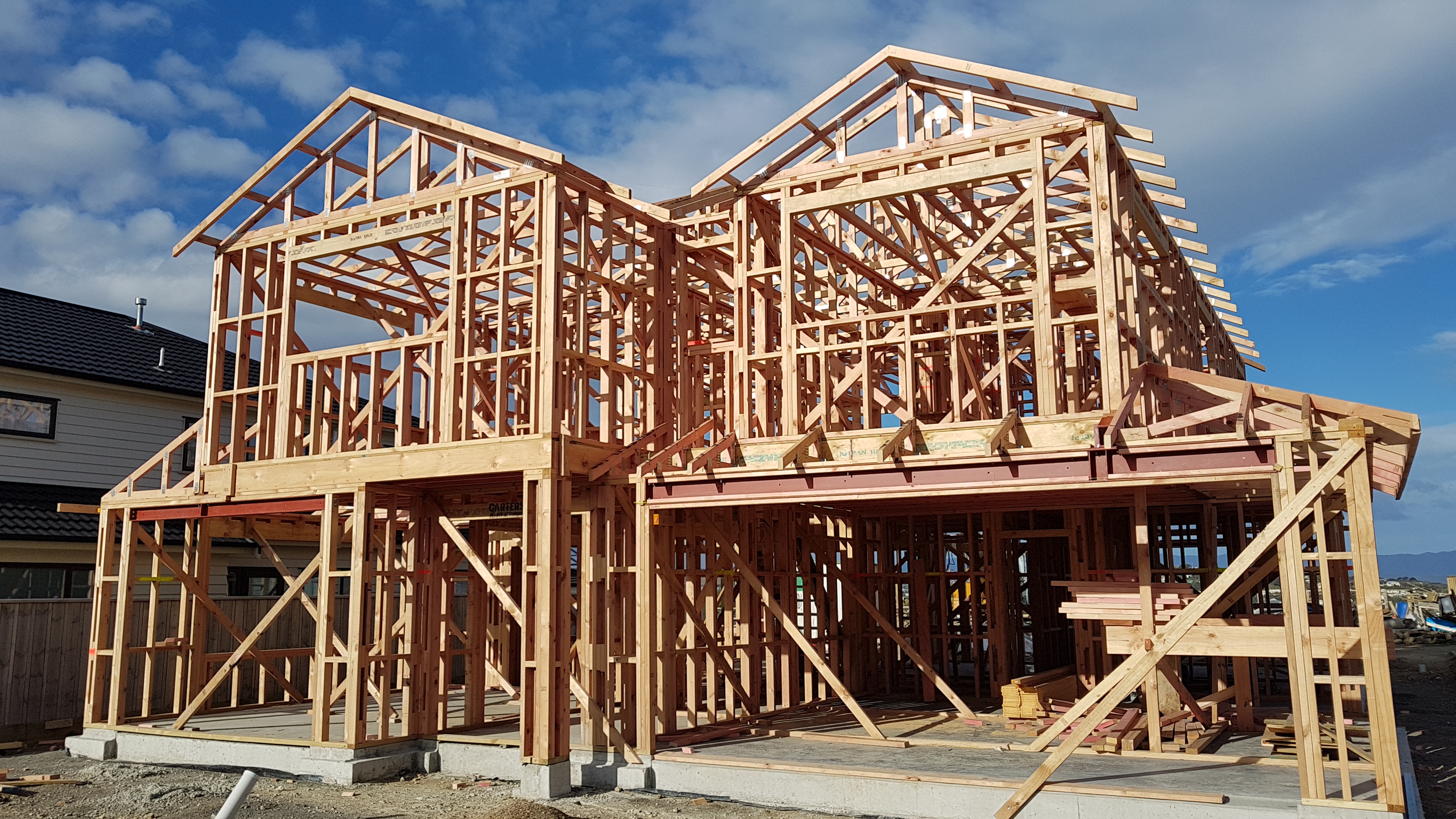
Wall assembly in Polish context
To meet WT 2021 requirements (U-value ≤ 0.20 W/m²K for external walls), timber-frame panels in Poland are typically built with:
- Structural stud layer (140–200 mm) filled with mineral wool or blown cellulose
- External service cavity or additional insulation layer (50–80 mm)
- Vapour control layer on the warm side
- External cladding: fibre-cement board, wooden boards, or render on a carrier board
3. Structural Insulated Panels (SIP)
SIP panels consist of an insulating foam core (expanded polystyrene or polyisocyanurate) bonded between two structural facing boards, typically OSB. The composite action of the sandwich panel carries both vertical loads and lateral forces, eliminating the need for a separate stud frame.
In Poland, SIP has remained a niche option compared to timber-frame or masonry. The main technical advantage is that the wall section is inherently airtight — the foam core has very low vapour permeability — simplifying compliance with the airtightness requirements of WT 2021.
SIP panels require careful detailing at junctions. Thermal bridges at panel edges and at window reveals are the most common points of performance loss, and these need to be addressed at the design stage rather than on site.
4. Large-panel concrete (wielka płyta)
Poland has a significant legacy of large-panel concrete prefabrication from the communist period (1960s–1980s). The wielka płyta system — factory-cast reinforced concrete floor and wall slabs — was used to construct the majority of the multi-family housing built during that era.
Contemporary large-panel prefabrication exists but is primarily oriented toward multi-family and commercial buildings rather than single-family self-build. For individual residential projects, it is rarely the economic or logistical first choice.
5. Hybrid systems
A number of manufacturers in Poland offer hybrid approaches, typically combining a timber-frame structure with factory-installed insulation and external cladding, but leaving internal finishing to be completed on site. This reduces transport complexity compared to fully volumetric modules while still compressing the weathertight shell schedule.
| System | Factory completion | On-site shell time | Main advantage |
|---|---|---|---|
| Volumetric modular | High (70–90%) | Days to 2 weeks | Fastest overall schedule |
| Timber-frame panels | Medium (50–70%) | 1–4 weeks | Widely available, flexible design |
| SIP | Medium | 1–3 weeks | Inherent airtightness |
| Large-panel concrete | High (structural) | Weeks to months | Structural robustness |
| Hybrid | Variable | 2–6 weeks (shell) | Balance of speed and flexibility |
Regulatory classification in Poland
Under Polish building law, the construction system used does not change the permit classification. A single-family prefab home is treated the same as a conventional one for permit purposes — the determining factors are building area, intended use, and location relative to the local spatial plan (MPZP). However, the structural documentation submitted to the building authority must reflect the actual system, and some systems — notably volumetric modular — may require additional technical approvals if manufactured abroad.